Einkaufswagen
0
How Big Is an ID Card? Standard ID Card Sizes & Dimensions Guide
How big is an ID card? A standard ID-1 card measures 85.60 × 53.98 mm (3.370 × 2.125 inches)—the familiar size used for credit cards and many identification cards.
But knowing the dimensions matters for more than identifying the card format. If you carry an ID as part of your everyday carry or tactical gear setup, card size can affect the holder you choose, how you organize other essentials, and how easily you can access them.
This guide covers standard ID card dimensions in inches and millimeters, how they compare with credit cards, and what to consider when choosing a practical way to carry your ID.
Quick answer: The nominal dimensions of a standard ID-1 card are 85.60 × 53.98 mm, or approximately 3.370 × 2.125 inches.
What Is the Standard ID Card Size?

The ISO/IEC 7810 standard defines the nominal dimensions of an ID-1 card as 85.60 × 53.98 mm.
Converted into other common units, that's:
- 3.370 × 2.125 inches
- 85.60 × 53.98 millimeters
- 8.560 × 5.398 centimeters
The ID-1 format is commonly associated with credit and payment cards as well as certain identification cards.
However, not every ID card or badge uses the ID-1 format. Employee badges, access credentials, event passes, organization-specific IDs, and other forms of identification can use different dimensions.
If you're trying to determine the size of a particular ID, measuring the physical card or checking its official specifications is more reliable than assuming it follows the ID-1 format.
Standard ID Card Dimensions at a Glance
Here's a quick reference for standard ID-1 card dimensions:
| Card Format | Inches | Millimeters | Centimeters | Common Use |
|---|---|---|---|---|
| ID-1 | 3.370 × 2.125 in | 85.60 × 53.98 mm | 8.560 × 5.398 cm | Credit/payment cards and certain identification cards |
These measurements describe the card's nominal width and height.
They should not automatically be treated as the required inside dimensions of whatever you use to carry the card. Actual fit depends on factors such as construction, opening size, card capacity, orientation, and retention design.
Why Do ID Card Dimensions Matter?
Knowing your ID card size is useful whenever you need to carry, organize, display, or protect identification.
Even when a product is described as fitting a "standard ID card," checking the actual measurements can help prevent fit problems.
This becomes especially relevant when your ID is part of a broader everyday carry setup alongside other items such as payment cards, small essentials, or writing tools.
For the most reliable fit, compare the dimensions of the card you actually carry with the specifications of the gear you're considering.
Are ID Cards the Same Size as Credit Cards?
Some ID cards are the same size as credit cards, but not all of them are.
Credit and payment cards commonly use the ID-1 format, with nominal dimensions of 85.60 × 53.98 mm (3.370 × 2.125 inches).
If an identification card also follows the ID-1 format, its nominal width and height are therefore the same.
However, "ID card" is a broad term. Employee credentials, access badges, event passes, licenses, and organization-specific identification can use other formats.
So if you're trying to determine whether your specific ID is credit-card sized, don't rely on the name alone.
Measure the actual card or check its official dimensions.
Can ID Cards and Credit Cards Be Carried Together?
Potentially, yes—when they use compatible dimensions and the carrying solution is designed with sufficient capacity.
But size isn't the only consideration. If you're organizing multiple cards together, also consider:
- Number of cards
- Card thickness
- Access
- Orientation
- Retention
- Other items you need to carry
For an EDC setup, thinking about everything you carry together is often more useful than considering each card in isolation.
Horizontal vs. Vertical ID Cards
Card size and card orientation are two different things.
A horizontal ID card, also called landscape orientation, presents the longer edge from left to right.
A vertical ID card, or portrait orientation, presents the shorter edge from left to right.
A card can therefore maintain the same physical dimensions while being designed for a different viewing orientation.
For example, an ID-1-size card remains 85.60 × 53.98 mm regardless of whether its printed design is horizontal or vertical.
Why Does Orientation Matter?
Orientation can affect how your identification is displayed, positioned, and accessed.
If you need an ID to remain visible, the orientation of both the card and its carrying setup becomes particularly important.
If you primarily need to store identification rather than display it continuously, orientation may be less important than overall dimensions, capacity, retention, and accessibility.
The key is to consider how you actually use the card, not just whether it physically fits.
Why ID Card Size Matters for Everyday Carry
Knowing your ID card dimensions isn't only useful when checking a badge format. It can also help you build a more organized everyday carry setup.
If you regularly carry identification together with credit cards, small essentials, or writing tools, the size and quantity of those items affect how compact your setup can be.
A setup that's too small may not accommodate everything you need. One that's unnecessarily large can add bulk without providing useful organization.
Instead of starting with the carrying gear, start with the things you actually use.
Ask yourself:
- Which cards do I carry every day?
- Do I need to carry more than one card?
- Do I need my ID to remain visible?
- How frequently do I need to access it?
- Do I also carry coins or other small items?
- Do I want to keep a pen or writing tool nearby?
- Where will this setup sit within the rest of my gear?
This approach works particularly well for EDC because everyday carry should reflect your actual routine rather than a generic list of equipment.
Start with what you carry. Then choose the gear around it.
How to Choose the Right ID Card Holder Size
Start with the actual dimensions of your card, rather than assuming that the phrase "standard size" guarantees compatibility.
Measure or verify the card's:
- Width
- Height
- Thickness, when relevant
For an ID-1 card, the nominal reference dimensions are:
85.60 × 53.98 mm (3.370 × 2.125 inches).
Next, compare those measurements with the specifications of the product you're considering.
But don't stop at width and height.
If your everyday carry includes multiple items, think about the complete carry setup.
For example, someone who only needs to carry one identification card may have very different requirements from someone who wants to keep an ID, payment cards, small items, and a writing tool organized together.
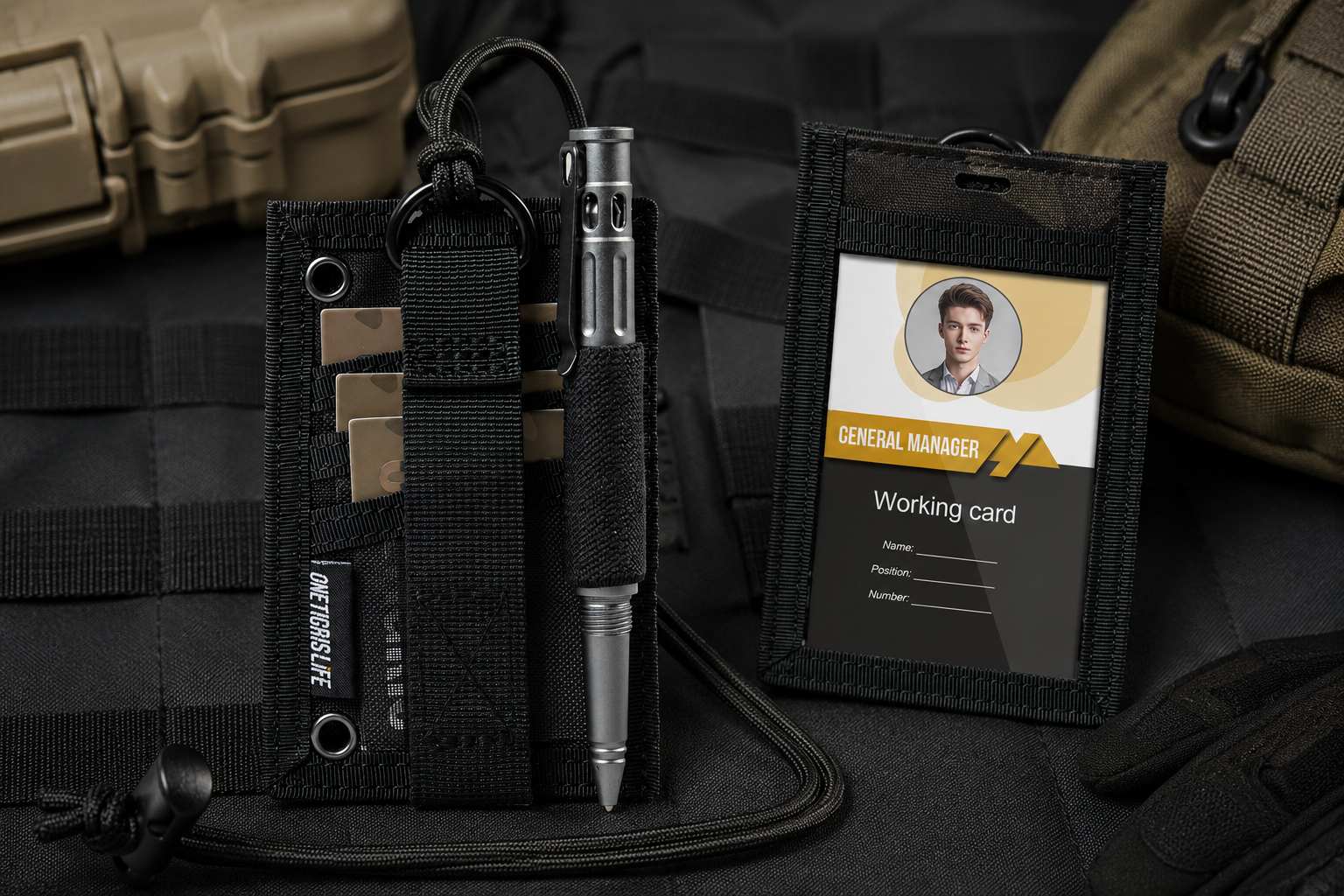
If you want to keep ID cards, credit cards, coins, and a pen organized in one compact tactical setup, explore the OneTigris ID Card Holder and compare its listed dimensions and features with the items you carry.
For fit and compatibility, always rely on the specifications provided on the individual product page rather than assuming that every card or carrying setup uses identical dimensions.

What to Look for in an ID Card Holder for EDC & Tactical Use
Once you know the dimensions of your card, the next question is how you want to carry it.
For an EDC or tactical gear setup, consider the complete combination of size, capacity, organization, access, attachment, and retention.
Card Size Compatibility
Start with the basics: your card needs to fit.
Compare the width and height of your actual identification with the supported dimensions of the product you're considering.
For an ID-1 card, the nominal reference size is 85.60 × 53.98 mm.
Don't assume compatibility based solely on product terminology. Two products intended to carry identification may still have different internal dimensions or capacities.
Carry Capacity
Think beyond a single ID.
Do you carry:
- One identification card?
- Multiple IDs?
- Credit or payment cards?
- Small everyday essentials?
- Coins?
- A pen or writing tool?
The goal isn't necessarily to carry more. It's to determine whether the gear can organize the items you already need.
For EDC, a more useful question is often:
"What do I actually carry every day?"
Build your setup around that answer.
Card Orientation
Consider whether your ID needs to sit horizontally or vertically.
This is especially relevant when identification needs to remain visible or quickly recognizable.
If the card is primarily stored rather than displayed, orientation may be less important than access and retention.
Attachment Method
Consider where the setup will be carried and how it needs to integrate with your other equipment.
Different products can use different attachment methods, and compatibility shouldn't be assumed.
Check the individual product specifications before deciding whether a particular option works with your clothing, pack, vest, belt, or other equipment.
Material and Durability
Material and construction influence how gear behaves in everyday use.
Depending on the product, these factors can affect flexibility, weight, protection, and durability.
Instead of relying on broad descriptions such as "heavy duty" or "military grade," check the actual materials and construction information provided by the manufacturer.
Choose according to your intended use.
Quick Access
Think about how frequently you need your identification.
If you're regularly presenting an ID or using an access credential, quick access may be a priority.
If the card is only needed occasionally, you may prioritize organization or retention instead.
The best setup balances accessibility with the way you actually use your gear.
Protection and Retention
An identification card that fits physically still needs to remain appropriately retained for your intended use.
Consider whether you need the card to be:
- Visible
- Covered
- Quickly removable
- Securely retained
- Separated from other items
There isn't one correct solution for every user.
Card dimensions tell you what may fit. Your everyday routine determines how you should carry it.
Building a More Organized EDC Setup
A practical everyday carry setup doesn't need to include a long list of equipment.
Start with what you genuinely use.
For example, if your daily essentials include an ID, a couple of payment cards, a pen, and a few small items, organizing those items together may make more sense than carrying several separate pieces of gear.
On the other hand, if you frequently need to present identification, keeping the card independently accessible may be more useful.
Consider three questions:
What do I carry?
Identify the items you actually need.
How often do I use them?
Frequently used items generally benefit from easier access.
Where do I carry them?
Your pocket, bag, belt, vest, or other equipment can change what type of organization makes sense.
This keeps your EDC focused on function rather than simply adding more gear.
ID Card Size FAQ
What is the standard size of an ID card?
The nominal dimensions of an ISO/IEC 7810 ID-1 card are 85.60 × 53.98 mm, or approximately 3.370 × 2.125 inches. However, not every identification card or badge uses the ID-1 format, so check the dimensions of your specific card when fit matters.
How big is an ID card in inches?
A standard ID-1 card measures approximately 3.370 inches wide by 2.125 inches high. Other identification cards, credentials, and badges may use different dimensions.
How big is an ID card in millimeters?
A standard ISO/IEC 7810 ID-1 card has nominal dimensions of 85.60 mm × 53.98 mm. This is the familiar format associated with credit and payment cards and certain identification cards.
Are ID cards the same size as credit cards?
Some are. Credit cards commonly use the ID-1 format of 85.60 × 53.98 mm (3.370 × 2.125 inches). An identification card that follows the ID-1 format has the same nominal width and height, but not every ID or badge follows this format.
What size ID card holder do I need?
Choose based on the actual width, height, and, when relevant, thickness of your identification card. For an ID-1 card, start with 85.60 × 53.98 mm, then compare those measurements with the specifications and card capacity of the product you're considering.